As world leaders and technology executives gathered in New Delhi for the India-AI Impact Summit 2026 to discuss governance, employment disruption and global cooperation in artificial intelligence, another reality quietly shaped the future of the technology: an unprecedented surge in financial investment.
Artificial intelligence became one of the largest investment waves in modern history, driven largely by private capital rather than government-led initiatives.
Over the previous decade, corporations, venture capital firms and global investors poured vast resources into AI development, transforming it from an emerging technology into a central pillar of economic competition and innovation.
According to forecasts by research and advisory firm Gartner, global spending on artificial intelligence was expected to reach $2.5 trillion in 2026, marking a 44 percent increase compared with 2025.
The scale of this investment placed AI spending far beyond the cost of many of humanity’s most ambitious scientific and infrastructure projects.
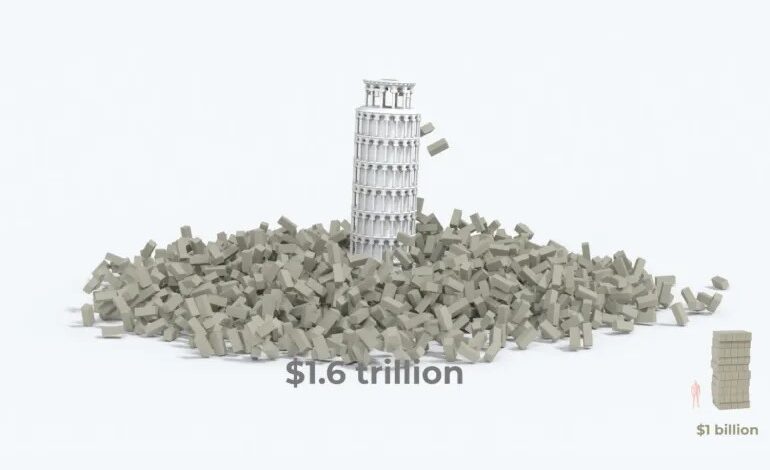
Understanding such enormous figures proved difficult without comparison. A single billion dollars, when visualized using stacks of $100 bills, formed a structure more than five meters high, Al-Jazeera reports.
Spending one dollar every second took 31 years to exhaust a billion dollars, and roughly 31,000 years to reach one trillion.
In practical terms, one billion dollars was equivalent to building several modern football stadiums, purchasing ten luxury private jets, or financing one of the world’s largest cultural landmarks such as the Grand Egyptian Museum.
The global technology sector had already moved far beyond that scale. Data from the 2025 AI Index Report published by Stanford University showed that corporate investment in artificial intelligence reached $1.6 trillion between 2013 and 2024 — nearly thirteen times higher than early-decade levels. This figure alone exceeded the cost of many historic mega-projects when adjusted for inflation.
For comparison, the Manhattan Project, which produced the first atomic bomb during World War II, cost about $36 billion in today’s dollars.
The International Space Station required roughly $150 billion, while the Apollo program that carried humans to the moon reached about $250 billion.
Even the massive United States Interstate Highway System, constructed over decades and spanning tens of thousands of kilometers, cost an estimated $620 billion.
Within little more than a decade, private investment in AI surpassed all of these landmark undertakings combined.
Unlike earlier mega-projects driven by wartime urgency or national prestige, artificial intelligence expansion was fueled primarily by market forces.
Investments flowed through mergers and acquisitions, research and development spending, startup funding and public offerings, reflecting a global race among companies seeking technological leadership.
The distribution of AI investment was heavily concentrated in a small number of countries that emerged as global innovation hubs.
The United States led by a wide margin, accounting for approximately 62 percent of private AI funding since 2013. American companies invested about $471 billion during that period, supporting nearly 7,000 newly funded AI firms.
China ranked second with $119 billion invested and more than 1,600 startups, followed by the United Kingdom with $28 billion. Canada, Israel, Germany, India, France, South Korea and Singapore also represented significant centers of activity, each contributing billions of dollars to the sector’s rapid expansion.
These figures did not include direct government spending programs such as semiconductor subsidies or national AI initiatives, meaning the true global financial commitment to artificial intelligence was even larger.
Looking ahead, analysts expected spending growth to accelerate further as companies and governments invested heavily in infrastructure needed to power AI systems.
Gartner forecast that the largest share of expenditure in 2026 would go toward building and expanding data centers and computing infrastructure, estimated at $1.37 trillion.
AI services were projected to account for $589 billion, followed by software at $452 billion and cybersecurity solutions at $51 billion.
Additional investment targeted machine-learning platforms, AI models, application development tools and data management systems.
By 2027, global AI spending was expected to exceed $3.3 trillion, underscoring how artificial intelligence was rapidly becoming one of the defining economic forces of the 21st century.
As policymakers debated regulation and societies grappled with the technology’s impact on jobs and governance, the sheer scale of investment suggested that AI’s expansion was not merely a technological trend but a transformation comparable to the industrial revolutions of the past.