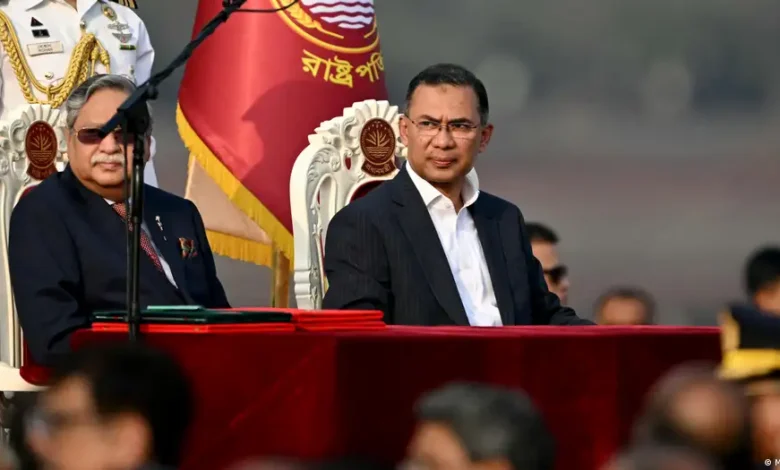
Tarique Rahman has been sworn in as the new prime minister of Bangladesh after his Bangladesh Nationalist Party (BNP) handily won parliamentary elections last week.
The 60-year-old is the son of former Prime Minister Khaleda Zia and assassinated President Ziaur Rahman and will serve a five-year term. President Mohammed Shahabuddin administered the oath of office for Rahman and dozens of Cabinet members and members of the new government were also sworn in.
“I will faithfully discharge the duties of the office of prime minister of the government, in accordance with the law,” he said during the ceremony outside the parliament building.
With his swearing in, Rahman replaces an interim government led by Nobel Peace Prize laureate Muhammad Yunus that oversaw the election, which was largely peaceful and widely accepted by international observers.
Lawmakers, who all promised loyalty to Bangladesh, were earlier sworn in to parliament by the Chief Election Commissioner AMM Nasir Uddin. The BNP members then chose Rahman as their leader.
Big challenges for new government
Rahman’s government’s biggest initial challenges will include restoring political stability, rebuilding investor confidence and reviving key industries such as the garment sector after the prolonged turmoil following the Gen Z-led uprising that toppled Sheikh Hasina’s government in 2024.
A BNP-led alliance won 212 seats in the 350-seat Parliament, while an 11-party coalition led by the Jamaat-e-Islami party, the country’s largest Islamist party, won 77 seats to be the opposition.
“This victory belongs to Bangladesh, belongs to democracy,” Rahman said in his victory speech on Saturday. “This victory belongs to people who aspire to and have sacrificed for democracy.”
On Saturday, he has also called for all parties to “remain united” in a country polarised by years of bitter rivalry.
“We are about to begin our journey in a situation marked by a fragile economy left behind by the authoritarian regime, weakened constitutional and statutory institutions, and a deteriorating law and order situation,” he said.
Jamaat leader Shafiqur Rahman, 67, said the Islamist party would “serve as a vigilant, principled, and peaceful opposition.
Rahman’s main rival, the Bangladesh Awami League, headed by Hasina, was banned from participating in the elections. From her exile in India, Hasina said the vote was unfair to her party. A court in Banglassh sentenced her to death for crimes against humanity because of hundreds of deaths involving the Gen-Z uprising.
Voters in Bangladesh elect 300 members of Parliament directly and the remaining 50 posts are reserved for women and distributed proportionately.