Kuwait’s skies to witness annular solar eclipse Tuesday, total lunar eclipse March 3
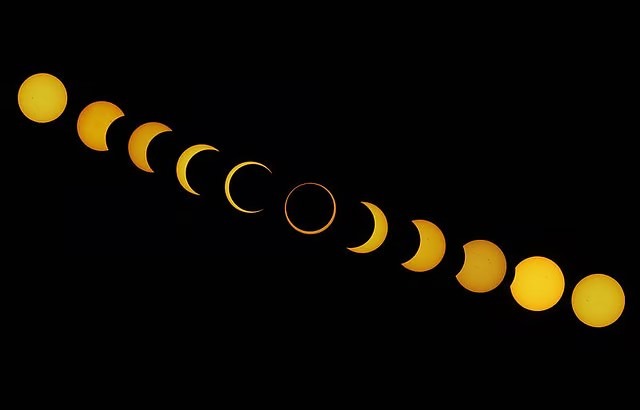
The Al-Ujairi Scientific Center has announced that the world will witness an annular solar eclipse tomorrow, Tuesday, February 17 — known as the “Ring of Fire”, and occurs when the Moon passes directly between the Earth and Sun but appears slightly smaller, leaves a bright halo around its edges will last up to 2 minutes and 20 seconds — followed by a total lunar eclipse on March 3.
The Center Director Yousef Al-Ujairi told Kuwait News Agency (KUNA) that the annular solar eclipse is expected around 3:00 PM Kuwait time, but it will not be visible from Kuwait. Its main path will be centered over Antarctica and will extend to parts of South Africa and Chile.
Al-Ujairi explained that this will be the first solar eclipse of the year and is marked by a striking optical phenomenon known as the “ring of fire”, which occurs when the moon does not completely cover the sun’s disk due to its relative distance from Earth, leaving a bright ring around the dark lunar disk. The path of the annular eclipse, where the full “ring of fire” is visible, will span approximately 4,282 kilometers.
The eclipse will also be partially visible across a wide geographical area, including Antarctica, Southeast Africa, the southernmost tip of South America, and large portions of the Pacific, Indian, Atlantic, and Southern Oceans. The percentage of the sun’s disk covered will vary depending on location, reaching a maximum of about 88 percent in the Australian Heard and McDonald Islands, as well as in the French Southern Territories and Antarctica.
Looking ahead to the total lunar eclipse, Al-Ujairi noted that the moon will turn a dark red color, a phenomenon often referred to as a “blood moon”. This spectacle will last for roughly 58 minutes and will be visible in western North America, Australia, New Zealand, and East Asia.
The peak of the eclipse is expected at 2:00 PM Kuwait time on March 3, although it will not be visible from Kuwait as the viewing regions are concentrated in the Pacific Ocean and western North America.
During the eclipse, the portion of the moon that enters the Earth’s shadow will be approximately 1.15 times its diameter, resulting in the complete disappearance of the lunar disk at the peak.
Al-Ujairi emphasized the scientific and educational importance of observing these celestial phenomena, highlighting their role in promoting astronomical awareness and interest within the community.