- Reactions to the Budget were mixed. BJP MP Ravi Shankar Prasad described it as a blueprint for “Viksit Bharat 2047,” while Shiv Sena (UBT) MP Priyanka Chaturvedi called it “disappointing.” Union Minister Jyotiraditya Scindia termed it a progressive budget focusing on every sector of the economy.
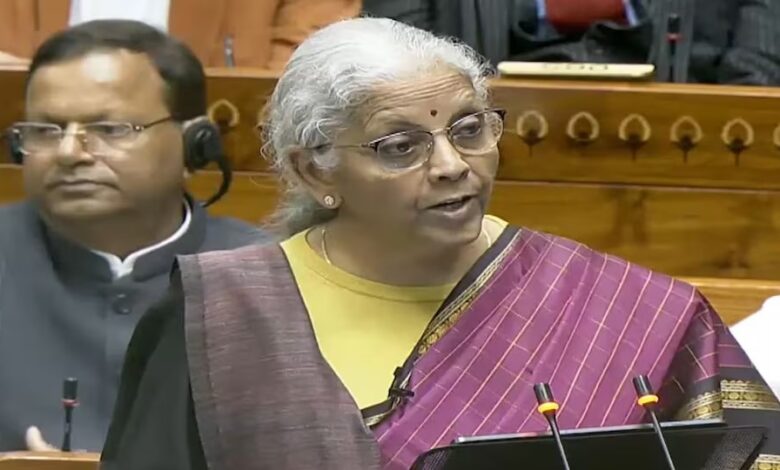
Finance Minister Nirmala Sitharaman today presented her ninth consecutive Union Budget under the leadership of Prime Minister Narendra Modi, emphasizing economic growth, competitiveness, and inclusive development.
Market reaction was negative, with stock indices falling during the budget presentation, reflecting investor caution. Income taxpayers, anticipating relief in the form of tax rebates or changes to the standard deduction, did not receive any concessions.

Sitharaman framed her 2026 budget around three ‘kartavyas’ (responsibilities):
- Accelerate and sustain economic growth by enhancing competitiveness.
- Fulfill the aspirations of citizens.
- Ensure equitable access to resources and opportunities for all families, communities, and regions.
Key Highlights of Union Budget 2026
Defence Spending Surge — The Defence Ministry received ₹2.19 lakh crore, a 21.84% increase, for modernization and capital expenditure in FY2026-27. Allocations include ₹63,733 crore for aircraft and aero engines, while revenue expenses for operations, maintenance, and salaries rose 17.24%, and pensions by 6.53% to ₹1.71 lakh crore. Overall, the defence budget totals ₹7.85 lakh crore.
Education Initiatives — The budget proposes five university townships near major industrial and logistics corridors to integrate multiple universities, research institutions, skill centers, and residential complexes. Additionally, one girls’ hostel per district will be established to enhance educational opportunities for female students.
Agriculture and Fisheries Development — The government plans the integrated development of 500 reservoirs and Amrit Sarovars for fisheries, along with initiatives supporting startups, women-led groups, and Fish Farmers Producer Organizations, NDTV reports.
Livestock Sector Boost — A loan-linked capital subsidy scheme will train over 20,000 veterinarians and support veterinary colleges, hospitals, labs, and breeding facilities in the private sector, recognizing livestock as a key contributor to farm income.
Taxation & Financial Measures:
Sovereign Gold Bonds (SGBs): Capital gains exemption removed for secondary market buyers from April 1, 2026; only original subscribers retaining bonds till maturity keep the full exemption.
TDS Simplification: Non-resident property buyers can now deposit TDS using a PAN-based challan, eliminating the need for a TAN.
Essential Medicines: Basic customs duty exempted on 17 critical cancer drugs, and seven more rare diseases included under duty exemptions for personal imports.
Aviation Sector Support: Customs duty exemptions for aircraft parts, seaplane manufacturing, and component parts aim to encourage domestic production and maintenance in both defence and civilian aviation.
Political and Regional Observations: Analysts noted no significant allocations for Tamil Nadu, unlike last year’s focus on Bihar, highlighting the regional political dynamics ahead of state elections.
Reactions to the Budget were mixed. BJP MP Ravi Shankar Prasad described it as a blueprint for “Viksit Bharat 2047,” while Shiv Sena (UBT) MP Priyanka Chaturvedi called it “disappointing.” Union Minister Jyotiraditya Scindia termed it a progressive budget focusing on every sector of the economy.
The Finance Minister’s budget speech lasted 84 minutes, with the Finance Bill 2026 introduced in the Lok Sabha, setting the stage for detailed parliamentary scrutiny.