Youth at Center of India’s March Towards Viksit Bharat
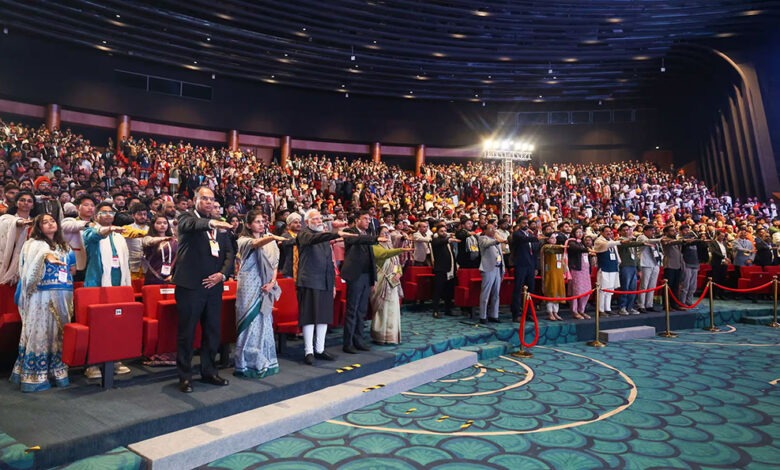
In his address at the concluding session of the ‘Viksit Bharat Young Leaders Dialogue 2026’ in New Delhi on 12 January, Indian Prime Minister Narendra Modi emphasized that the period leading up to 2047, when India marks 100 years of independence, is a decisive phase for both the nation and its youth. He stated that the strength and capabilities of young Indians will shape India’s strength, and their success will elevate the country to new heights. He further underscored the critical role of youth leadership in achieving the vision of a developed India.
Noting that the event coincides with the birth anniversary of Swami Vivekananda. “Remembering Swami Vivekananda, we celebrate National Youth Day every year on 12 January. Inspired by his ideals, 12 January has been chosen for the Viksit Bharat Young Leaders Dialogue. The life of Swami Vivekananda is a great guiding light for all of us”, Shri Modi emphasised.
Expressing satisfaction over the rapid growth of the Viksit Bharat Young Leaders Dialogue, Shri Modi described it as a powerful platform enabling direct youth participation in shaping India’s development agenda. “The association of crores of young people with this initiative—more than five million registrations, over three million youths participating in the Viksit Bharat Challenge—and sharing their ideas for the nation’s development, such large-scale engagement of youth power is unprecedented”, Shri Modi highlighted.
Appreciating the quality of inputs, the Prime Minister particularly lauded the thoughtful ideas presented on key themes such as Women-Led Development and Youth Participation in Democracy. Referring to the presentations made during the event, he said they reflect the strong resolve of India’s Amrit Peedhi—the generation responsible to build India over the next 25 years—to build a developed nation.
The Prime Minister also underlined the creativity and innovative spirit of India’s Gen Z and congratulated all young participants and members of the Mera Yuva Bharat organization for the successful conduct of the dialogue. The Prime Minister recalled the period before 2014, describing it as an era of policy paralysis, excessive red tape, and limited opportunities for youth. He noted that young people then faced cumbersome procedures for jobs, exams, and starting businesses, with delays in decision-making and poor implementation of policies. He emphasized that what seems abnormal today was routine a decade ago, highlighting how governance reforms have since changed the experience of India’s youth.
The Prime Minister cited the startup ecosystem as an example of change, noting that despite global growth in startup culture over decades, India had very limited focus on startups before 2014. “Until 2014, there were fewer than 500 registered startups in the country. In the absence of a startup culture, government intervention dominated every sector. Our youth talent, their capabilities, did not get the opportunity to fulfill their dreams”, Shri Modi remarked.
The Prime Minister emphasized his trust in the capabilities of India’s youth, stating that this confidence led to a new development approach focused on empowering young innovators. He highlighted key reforms and initiatives such as Startup India, Digital India, Ease of Doing Business, and simplification of tax and compliance, which accelerated India’s startup revolution by opening previously government-dominated sectors to entrepreneurship.
Citing the space sector as a major example, Shri Modi said, “Until 5–6 years ago, the responsibility of advancing the space sector rested solely with ISRO. We opened the space sector to private enterprise, and created supporting frameworks and institutions.” Shri Modi noted that opening it to private participation has led to the emergence of over 300 startups. He highlighted achievements by Skyroot Aerospace and Agnikul Cosmos as evidence of how youth-led innovation is transforming India into a global leader in emerging technologies.
The Prime Minister highlighted how easing restrictive regulations transformed the drone sector, which was earlier burdened by complex laws and licensing. “Simplified rules enabled youth-led growth in drone technology, benefiting national security and agriculture through Made-in-India drones and initiatives like the Namo Drone Didis”, he added.
He also noted major reforms in the defence sector, which public enterprises once dominated. “Today, more than 1,000 defence startups are operating in India. One young person is building drones, another is developing anti-drone systems, someone is creating AI-powered cameras, while others are working in robotics,” Shri Modi underscored.
The Prime Minister highlighted the impact of the Digital India initiative in nurturing a new generation of creators and driving the growth of India’s Orange Economy, centred on culture, content, and creativity. “India is witnessing unprecedented growth in the ‘Orange Economy’, that is, culture, content, and creativity. India is emerging as a major global hub in areas such as media, film, gaming, music, digital content, and VR-XR” Shri Modi noted.
“The ‘World Audio-Visual and Entertainment Summit’ (WAVES) has become a major launch pad for young creators. In other words, no matter the sector, the doors of limitless opportunities are opening in India today,” Shri Modi added. He urged youth to pursue their ideas boldly, assuring them of the government’s continued support.
The Prime Minister stated that the reform agenda initiated over the last decade has accelerated, with youth at its core. He highlighted next-generation GST reforms and tax relief up to ₹12 lakh as measures that simplify processes and increase savings for young professionals and entrepreneurs. Emphasizing the growing demand for energy driven by AI and advanced manufacturing, he noted that reforms in civil nuclear energy, the SHANTI Act, aim to ensure an assured power supply, generate large-scale employment, and create positive spillover effects across the economy.
The Prime Minister highlighted global workforce shortages and emphasized India’s strategy to prepare its youth for international opportunities. “Our effort is to ensure that India’s youth are prepared for the opportunities emerging across the world. Therefore, continuous reforms are being carried out in sectors related to skill development”, Shri Modi underlined. He reiterated that after the new National Education Policy, regulations related to higher education are now being reformed. “Foreign universities are also opening their campuses in India. Recently, the PM SETU Programme was launched with investments worth thousands of crores of rupees. Under this, thousands of ITIs will be upgraded so that youth can be trained in line with the current and future needs of industry”, Shri Modi noted.
The Prime Minister stressed that self-confidence is essential for a country to be self-reliant and developed. He also highlighted the importance of being open to global knowledge while valuing India’s own heritage, quoting the Vedic phrase ‘Aano Bhadrāh Kratavo Yantu Vishwatah’, meaning ‘Let auspicious, beneficial, and excellent thoughts come to us from all directions’. “You must learn from the best practices around the world, but never let the tendency to undervalue your own heritage and ideas dominate”, Shri Modi stated.
Shri Modi cited Swami Vivekananda who embraced global ideas but challenged misconceptions about India, inspiring a vision for a better nation. He encouraged youth to advance with energy, maintain fitness, and embrace joy, expressing unwavering faith in their potential. “I have complete faith in all of you, in your capabilities and energy. With these words, I once again wish you all a very Happy National Youth Day”, the Prime Minister concluded.