Republic Day of India: a celebration of sovereignty and democracy

Sheza Fathima Naushad
IX-A, Aspire Indian International School
Special to The Times Kuwait
The Republic Day of India is celebrated to honor the occasion when the Constitution was adopted in 1950. This day marks the date on which the Constituent Assembly of India formally enacted the Constitution, specially drafted for an independent India, on 26th January 1950. The newly drafted Constitution replaced the Government of India Act 1935 and came into force, establishing India as a sovereign republic. Since then, Republic Day has been observed every year as one of the country’s most important national events.
The significance of 26th January also dates back to 1930, when the Indian National Congress publicly declared its Purna Swaraj (“Complete Self-Rule”) resolution. This decisive declaration rejected dominion status within the British Empire and established full sovereignty as the ultimate goal of India’s independence movement. While some leaders initially supported dominion status, the idea was gradually seen as inadequate, and the Congress Party unanimously adopted the resolution on 19th December 1929 under the leadership of Jawaharlal Nehru. The following month, January 26 was urged to be celebrated as Independence Day, a date that later gained special significance when India became a republic.
Although India officially achieved independence on 15th August 1947, January 26 retained historical importance. The Constitution was deliberately scheduled to come into effect on this date in 1950 to honor the 1930 declaration and mark India’s transformation into a republic. Today, Republic Day is celebrated across the country with patriotic fervor, reminding citizens that the nation is governed by laws made by the people, for the people.
The roots of Republic Day trace back to the Indian Independence Act of 18th July 1947, which ended British rule and transferred legislative authority to the Constituent Assembly of India. Tasked with drafting the nation’s Constitution, the Assembly formed a Drafting Committee chaired by Dr. B.R. Ambedkar, widely regarded as the “Father of the Indian Constitution.” A draft was submitted in November 1948, and the Assembly spent the following year debating and refining the document.
When the Constitution came into effect on January 26, 1950, it contained 395 articles in 22 parts and eight schedules. Since then, over 100 amendments have increased the number of articles to 448. The Constitution formally declared India as a sovereign, socialist, secular, democratic republic, guaranteeing justice, liberty, equality, and fraternity to all citizens. This foundational document continues to serve as the backbone of Indian democracy.
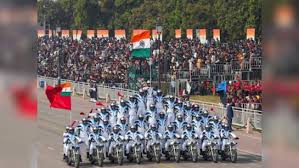
The main Republic Day celebration takes place in New Delhi, with a grand parade beginning at the Rashtrapati Bhavan, proceeding along a 3-mile route past India Gate, and concluding at the Red Fort. The parade showcases India’s cultural, historical, and military heritage. Before the parade, the Prime Minister pays homage to fallen soldiers by laying a wreath at the Amar Jawan Jyoti, observing a moment of silence to honor their sacrifices.
Republic Day is also a time to recognize exceptional service and bravery. The President of India confers several prestigious awards, including gallantry and civilian awards, police medals, children’s awards, and other bravery medals. These ceremonies celebrate the extraordinary achievements and dedication of Indian citizens, inspiring others to contribute to the nation’s progress.
Since 1950, India has invited a foreign dignitary as the chief guest to highlight diplomatic ties and global cooperation. The tradition began with Indonesian President Sukarno and has included notable figures such as Nelson Mandela in 1995, American President Barack Obama in 2015, ASEAN leaders in 2018, Egyptian President Abdel Fattah al-Sisi in 2023, and French President Emmanuel Macron in 2024. This practice underscores India’s commitment to international friendship and collaboration.
As India celebrates its 77th Republic Day on 26th January 2026, the occasion is a powerful reminder of the values enshrined in the Constitution. By honoring the sacrifices of freedom fighters and embracing our responsibilities, citizens pledge to uphold justice, liberty, equality, and fraternity, while striving to build a stronger, united, and prosperous India. Republic Day is not only a celebration but also a reaffirmation of the country’s democratic ideals and national pride.