Vatican lauds Kuwait as a model of religious co-existence
Vatican Secretary of State Cardinal Pietro Parolin
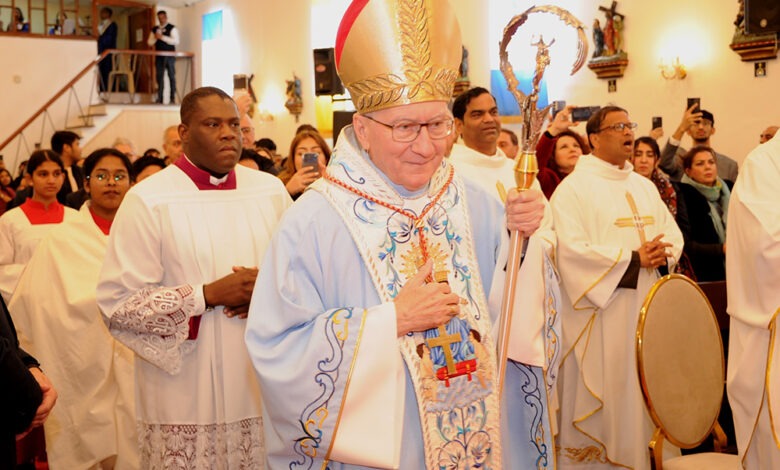
The Times Kuwait Report
Vatican Secretary of State Cardinal Pietro Parolin during his visit last week to Kuwait affirmed the Vatican’s deep appreciation for the longstanding relationship with Kuwait, describing it as one rooted in mutual respect, sincere dialogue, and a shared commitment to peace and human dignity.
Speaking to the media during his official visit to Kuwait, Cardinal Parolin emphasized both the pastoral and diplomatic importance of his visit, which coincided with the historic elevation of the Church of Our Lady of Arabia, in Ahmadi to the rank of Minor Basilica.
“The Holy See views its relationship with the State of Kuwait with sincere esteem and gratitude,” said Cardinal Parolin, noting that diplomatic ties between the two sides date back to 1968. He highlighted Kuwait’s distinctive place in the Holy See’s engagement with the Gulf, pointing to the country’s consistent climate of stability and hospitality that allows diverse communities to live side by side.
He added, “My visit is therefore both pastoral and diplomatic. Pastoral, because it is connected to a moment of great significance for the Catholic faithful; and diplomatic, because it expresses appreciation for the friendship and cooperation that have grown over decades between the Holy See and the State of Kuwait.”
Reflecting on the elevation of the Church of Our Lady of Arabia to a Minor Basilica, Cardinal Parolin described the title as a papal recognition of the church’s historical, spiritual, and pastoral importance. He said the designation strengthens the church’s bond with the universal Church and the See of Peter, while acknowledging its long-standing role as a spiritual home for Catholics in Kuwait and a point of reference for the wider Gulf.
“The message is one of encouragement and hope. Encouragement to the faithful that their life of prayer and service is valued; and hope that religious life—when lived with sincerity and respect—can be a force for harmony, not division,” said the Vatican Secretary of State.
Pointing to the historic significance of the church becoming the first Minor Basilica on the Arabian Peninsula, Cardinal Parolin described it as a powerful sign to the wider world of the importance of coexistence and dialogue. He added that the honor is also a moment of shared joy for Kuwait’s wider society, including the Muslim community. He explained: “Muslims hold a deep reverence for Our Blessed Mother, Mary/Miriam. Her figure unites Christians and Muslims alike in respect and love, making this recognition a moment of shared celebration.”
Kuwait’s experience of religious coexistence drew particular praise from the Holy See representative. He said the Vatican looks upon Kuwait’s religious approach with appreciation, especially in a region that has faced significant tensions. He added, “Kuwait has demonstrated a steady commitment to social cohesion and respect for others. This is not merely a policy, it is a culture expressed in daily life, and it deserves recognition.”
He stressed that coexistence requires patience, wisdom, and goodwill, adding that societies that protect dignity and cultivate mutual respect are better equipped to remain resilient during difficult times.
Addressing the situation of the Christian community in Kuwait, Cardinal Parolin described it as vibrant and spiritually active, composed largely of families and working people from many nations. He underlined the community’s strong sense of gratitude toward Kuwait and its commitment to respecting local laws and culture.
“The Church seeks to form responsible persons: people of prayer, honest work, respect for laws and culture, and care for one another,” he said. The Holy See, he added, encourages Catholics to be good residents who contribute positively through professionalism, family life, solidarity with the vulnerable, and a commitment to peace. “This is the Church’s vocation everywhere—to serve the common good,” he said.
Cardinal Parolin underscored the importance of freedom of worship, describing it as a measure of a society’s maturity and confidence. He said Kuwait’s experience demonstrates that protecting religious life can coexist with social harmony, benefiting society as a whole by strengthening trust, stability, and responsibility.
“This is particularly meaningful in a region where conflicts elsewhere have too often exploited religious identity for political ends,” he said.
On interfaith dialogue, Cardinal Parolin emphasized its essential role in fostering peace and stability in the Middle East, particularly when dialogue is practical rather than theoretical. “Dialogue means building relationships, correcting misunderstandings, and working together on what serves human dignity,” he said, citing education, family life, care for the poor, and the rejection of violence in God’s name as shared priorities.
He reaffirmed the Holy See’s long-standing investment in interfaith dialogue across the Middle East and the Gulf, welcoming all serious efforts that promote mutual understanding and a culture of peace. Cardinal Parolin also pointed to opportunities to strengthen diplomatic, cultural, and humanitarian cooperation with Kuwait. He praised Kuwait’s well-known humanitarian engagement and said that shared concern for human dignity provides a strong foundation for deeper collaboration.
He further noted, “Cultural cooperation is also important. Encounters that promote understanding between peoples and religions help prevent the stereotypes that so often become seeds of conflict,”
Speaking on extremism, Cardinal Parolin said religious leaders carry a grave responsibility to ensure that faith is never manipulated to justify hatred or violence. He stressed the need to teach clearly that the dignity of every human person is sacred and that true worship of God is inseparable from respect for one’s neighbor.
He also highlighted the responsibility of religious institutions to form young people in conscience, critical thinking, and compassion, stating that good education, strong families, just laws, and consistent moral leadership are the most effective responses to extremist narratives.
In his message to youth in Kuwait, Cardinal Parolin quoted Pope Leo XIV’s recent Message for the World Day of Peace: “We must promote self-awareness in civil societies, forms of responsible association, experiences of nonviolent participation and practices of restorative justice on both a small and large scale”.
He added, “Your future will be shaped by your ability to work with others, to listen, and to respect differences without fear. Diversity is not a threat when it is guided by mutual respect; it becomes a strength that enriches society.” He urged young people to become “builders of bridges in schools, workplaces, and online spaces, and to reject contempt, rumors, and suspicion in favor of friendship and truth.”
Reflecting on his visit, Cardinal Parolin said Kuwait leaves the impression of a society that values order, dignity, and hospitality—virtues he described as deeply needed in today’s world. Internationally, he said Kuwait’s credibility stems from its steadiness and commitment to dialogue.
“In a region, and a world, often tempted by polarization, Kuwait’s capacity to foster coexistence and to support humanitarian causes can be a constructive contribution,” he said, expressing the Holy See’s hope that Kuwait’s role will continue to grow for the benefit of the wider region.
Cardinal Parolin concluded by expressing heartfelt gratitude for the warm welcome he received during his stay. He thanked His Highness the Amir, Sheikh Meshal Al-Ahmad Al-Jaber Al-Sabah, the Crown Prince, the Prime Minister, and all state authorities for their gracious hospitality. He also conveyed his sincere appreciation to His Excellency Bishop Aldo Berardi, Apostolic Vicar of Northern Arabia, and to all those within the Church who worked with dedication and generosity to ensure the success of the visit.