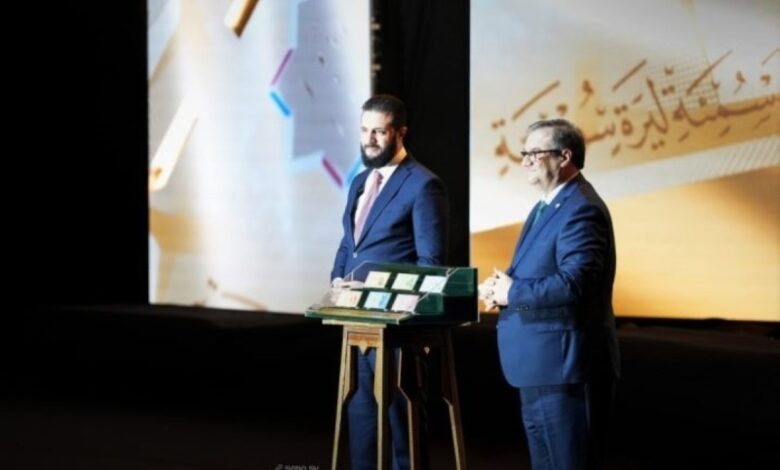
- The exchange process will start on Jan. 1, 2026, and run for 90 days, with a possible extension if needed
- Under the new system, every 100 old Syrian lira will be exchanged for one new lira. The initial denominations will include six values: 5, 10, 25, 50, 100 and 500 lira. In practical terms, a 500-lira banknote in the new currency will be equivalent to 50,000 lira under the previous system.
Syrian President Ahmed al-Sharaa, alongside Central Bank Governor Abdul Qader al-Hasriya, on Monday evening officially unveiled Syria’s new national currency, describing the move as a symbolic and administrative reset rather than an instant economic remedy.
Speaking at the announcement, President al-Sharaa said the decision followed prolonged deliberations and international study, noting that currency replacement and zero-removal policies have produced mixed results worldwide.
“There are six global experiences in changing currencies — some successful, others not,” he said, emphasizing that monetary reform is a highly sensitive process that must be handled with caution, reports Al-Rai daily.
Al-Sharaa framed the currency launch as a clear political and economic signal. He described it as the conclusion of a past phase “that is not mourned,” and the opening of a new chapter aligned with the aspirations of Syrians and regional observers hopeful for a modern Syrian reality. “This step,” he said, “represents the title of a new Syrian economy.”
However, the president was careful to manage expectations. He stressed that removing two zeros from the currency does not, by itself, improve economic performance or living standards. Rather, he explained, the reform is designed to simplify transactions, accounting and cash handling, without altering the real value of money.
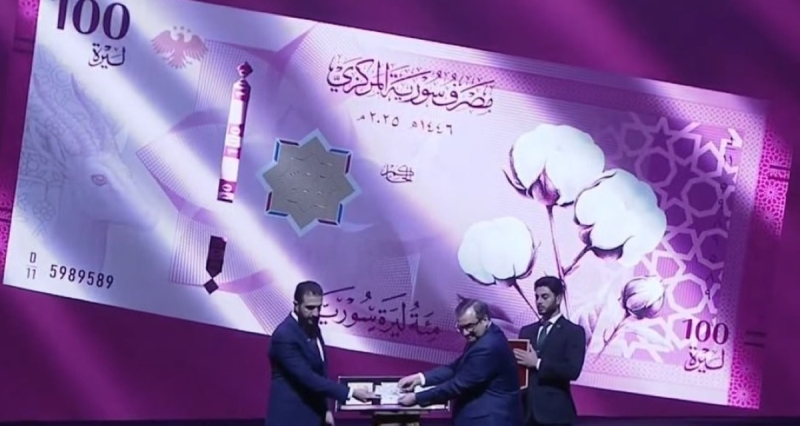
One of the most striking features of the new currency is its visual redesign. The new banknotes carry no images or political symbols, closing a chapter in which Syrian currency prominently featured portraits of former President Hafez al-Assad and his son Bashar.
Earlier, Central Bank Governor Abdul Qader al-Hasriya detailed the technical framework of the currency exchange. He said the conversion process would be carried out with flexibility and ease through 66 licensed exchange companies and more than 1,000 designated outlets across the country.
Under the new system, every 100 old Syrian lira will be exchanged for one new lira. The initial denominations will include six values: 5, 10, 25, 50, 100 and 500 lira. In practical terms, a 500-lira banknote in the new currency will be equivalent to 50,000 lira under the previous system.
Al-Hasriya emphasized that the reform does not involve any increase in the money supply and will not affect the currency’s real value, describing the change as purely nominal. “The purchasing power remains the same,” he said, adding that the redesign is intended to make cash easier to carry and manage.
The governor also revealed that the new currency incorporates advanced security features, as well as special design elements to assist the visually impaired and blind. He stressed that the removal of zeros would not disrupt the currency’s daily functions or its role in the economy.
In a further sign of normalization, Al-Hasriya announced that the Central Bank will reopen its branch in Idlib, aligning it with operations in other governorates.
He underscored that the Central Bank is the sole authority empowered to issue official information regarding the new currency and its denominations, calling on citizens to rely exclusively on official announcements. While the presidential decree authorizing the currency replacement does not specify a deadline for exchange, the Central Bank has been granted full discretion to manage the process gradually to ensure stability and prevent disruption.
Concluding his remarks, Al-Hasriya urged public cooperation to preserve confidence in the national currency, noting that forthcoming clarifications on exchange mechanisms would address any remaining uncertainty.
While the reform does not promise immediate economic relief, it marks a significant psychological and administrative shift — one that Syrian officials present as a foundation for a redefined monetary identity and a cautious step toward broader economic restructuring.