Beyond Box-Ticking: Rekindling Kuwait’s Ethics of Excellence for Vision 2035
What has happened to doing one’s best simply for its own sake?

By Sarah Al Sabah
Government Advisor & Communication Strategist
Special to The Times Kuwait
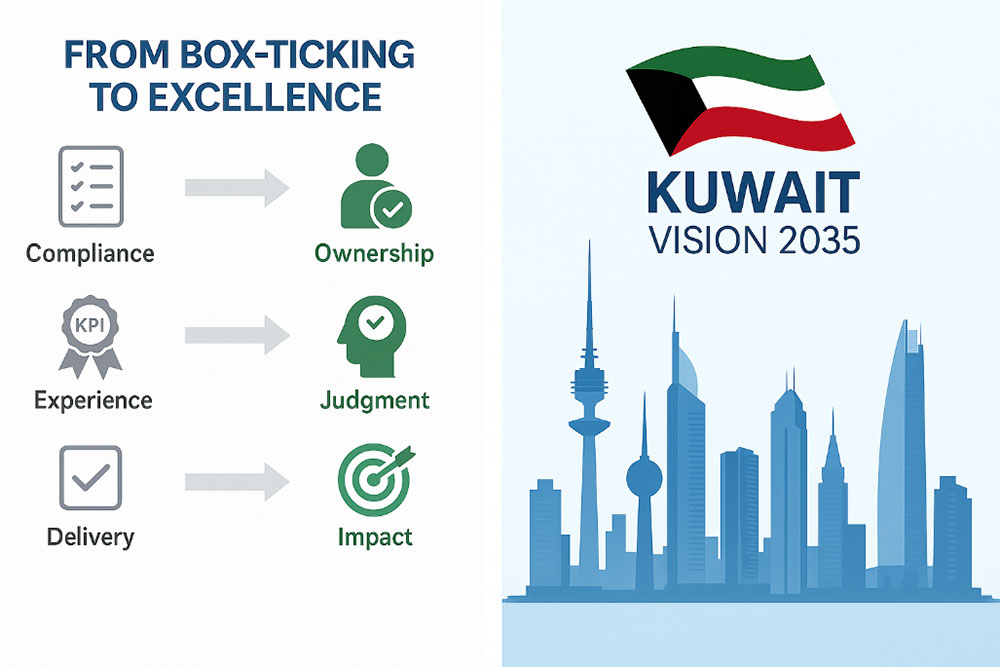
Across institutions, offices, and organizations, a troubling pattern has quietly taken hold: success is increasingly measured by completed checklists, and not by real impact. The ethics of excellence, the pride in going the extra mile and standing accountable for results, seems to be fading. Forms are filled. Procedures are followed. Reports are submitted. Yet too often, the deeper question is left unanswered: Did this action/decision/process actually make life better for the people we serve?
Bureaucratic inertia and siloed routines have crept in where passion and purpose once drove us. Somewhere along the way, responsibility was diluted into compliance, and accountability was reduced to avoiding blame rather than owning outcomes. Pride in workmanship, once a defining value, has been replaced by a culture of ‘minimum requirement met’.
This erosion matters deeply, because Vision 2035 was never meant to be a bureaucratic exercise. It is a national transformation agenda. An agenda that depends not only on policies and investments, but on mindset, behavior, and integrity. Vision 2035 calls for an effective, transparent, and high-performing state. A state powered by creative human capital and institutions worthy of public trust. No vision, however well written, can succeed if it is executed through box-ticking rather than ownership.
A service delivered ‘on paper’ but experienced as confusing, slow, or dismissive is not a success. A project launched but not sustained is not progress. A reform announced but not felt is not transformation. If we are serious about moving from box-ticking to excellence, Kuwait must begin measuring not only whether services are delivered, but how they are experienced.
Vision 2035: A blueprint Demanding Accountability: Kuwait’s leaders have not been blind to these challenges. Vision 2035 is fundamentally an aspiration to break free from business-as-usual. Launched in 2017, this Vision provides a blueprint for a thriving future. That future is drawn as a Kuwait with a diversified, sustainable economy and regional hub led by a dynamic private sector. Most importantly, Vision 2035 is not just about buildings and budgets.
Vision 2035 is about people and purpose. At its core are seven pillars targeting areas such as economic diversification, institutional reform, and human capital development. In other words, the plan explicitly recognizes that investing in our people and modernizing our institutions are the keys to sustainable growth. The Vision is a national call to lift our standards—in education, in government performance, in civic responsibility—to match the greatness we envision for Kuwait.
Under Vision 2035’s Creative Human Capital pillar, for example, Kuwait prioritizes empowering its youth and boosting women’s participation in the workforce. Vision Kuwait recognizes that no nation can prosper by leaving half its talent on the sidelines. Similarly, the Vision’s focus on governance aims for effective and transparent public administration. A government that serves people efficiently and with integrity. The plan’s objectives include raising government performance and refocusing resources on long-term impact.
Vision Kuwait’s architects clearly understood that without accountability and excellence in execution, even the grandest plans will falter. As one commentator put it, Kuwait’s challenge has not been ambition or ideas, but “a system that ensures plans turn into practice”. Vision 2035 explicitly ties success to improving government efficiency, transparency, and service quality. These goals all hinge on a culture where responsibility is embraced, not avoided.
Yet a vision on paper is not enough. For Vision 2035 to truly flourish, it must live in the hearts and work ethic of every Kuwaiti. It demands that we move beyond superficial compliance. We cannot achieve a ‘prosperous and sustainable Kuwait’ by 2035 with a checklist mentality. We will get there by fostering a culture of excellence. A culture where each project manager treats national goals as personal missions, each teacher strives to truly educate (not just finish the syllabus), each civil servant cuts red tape rather than adding to it. This cultural shift is not a soft, secondary aspect of development. Excellence mindset is the critical factor that will determine whether Kuwait’s lofty goals are met or missed. Good governance and accountable institutions are central to Vision 2035’s goals. Legislation and reforms are not enough without a culture of responsibility. Most importantly we need a returned pride in public service.
Human Capital: Excellence as a National Asset: One of the Vision 2035 pillars is aptly named ‘Creative Human Capital’. This reflects an understanding that Kuwait’s true wealth lies in its people. In our people’s skills, education, creativity, and ethic of work. Investing in infrastructure or technology will mean little if our human capital is not engaged and motivated to do their very best. Today, Kuwait boasts a young, educated population (around 60 percent under the age of 25), eager to contribute and innovate. These youth are the future engineers, teachers, entrepreneurs, and public servants who will carry Kuwait into its next era. We owe it to them to build a culture where talent is nurtured and effort is rewarded.
What does this mean in practice? It means overhauling how we educate and train. Moreover, It requires a transformation in how we inspire. Our schools and universities should not just impart degrees. Our education system should ignite a passion for learning excellence. Vision 2035 rightly calls for aligning education with the needs of a knowledge-based economy. The education system needs to close the gap between classroom and workplace.
Beyond curricula and training programs, we must model the values of integrity, diligence, and creativity at every turn. Young Kuwaitis need to see that success comes not from connections or formalities but from competence and hard work. If they observe that promotions go to those who innovate and perform, not merely those who linger longest in the office, they will emulate those behaviors.
Kuwait’s heavy reliance in past decades on public-sector employment (with the majority of working citizens holding government jobs) has unfortunately sometimes bred complacency. When a stable public job is virtually guaranteed, the incentive to outperform can diminish. Vision 2035 aims to change this by expanding private-sector opportunities and entrepreneurship.
With a dynamic private sector more Kuwaitis can thrive on merit and productivity rather than await a public paycheck. We see promising signs: more young people launching startups and seeking non-traditional careers, as well as reforms that support small businesses and freelancers. These trends must be encouraged with a supportive ecosystem. As well as, a social narrative that celebrates the self-made achiever more than the comfortable official.
Most importantly, human capital excellence means inculcating personal responsibility from an early age. In school, in university, and in entry-level jobs, our youth should be challenged to take ownership: of a project, of a community initiative, of their own learning. Programs like LOYAC’s youth leadership training and INJAZ Kuwait’s entrepreneurship coaching (already active for years) are great examples that instill a spirit of civic responsibility and problem-solving in our young people. These efforts align with Vision 2035’s human capital goals. They both cultivate not just job skills, but character and initiative.
As the UNDP Resident Representative in Kuwait noted, the countries that thrive are those that invest in “knowledge, innovation, and human capital,” putting youth at the heart of a diversified, knowledge-driven economy. Kuwait’s future depends on this: a generation of citizens who do not wait to be told what to do. Citizens who proactively seek to make things better, each in their own sphere.
[Next week, in the second part of this two-part series, we look at governance and integrity, and how we can engender a national ethos of accountability, and reclaim our national pride, as we pursue an ethics of excellence to achieve Vision 2035.]
Editors Note: This op-ed examines the cultural foundations required to realize Kuwait Vision 2035, arguing that national transformation depends as much on responsibility, accountability, and pride in public service as it does on policies and investments. The article invites reflection across leadership, institutions, and society on how excellence is practiced, and experienced, in everyday governance.