From desert to destination: Kuwait Geopark moves closer to global recognition
- Located north of Kuwait Bay, the Kuwait Geopark project is a national initiative aimed at reinforcing Kuwait’s position as a global destination for geology, archaeology, natural heritage and human history.
- The project is envisioned as an open-air museum and a “living memory” of the country’s environmental and cultural legacy.
- The project also seeks to enhance Kuwait’s international standing through inclusion in the global network of geoparks affiliated with UNESCO, while highlighting the historical depth that forms a core part of Kuwait’s national identity.
Minister of Information and Culture and Minister of State for Youth Affairs Abdulrahman Al-Mutairi affirmed on Saturday that the land designated for the Kuwait Geopark project is unique, stressing that efforts are underway to invest in the site in an attractive and sustainable manner that reflects its environmental, geological and historical significance.
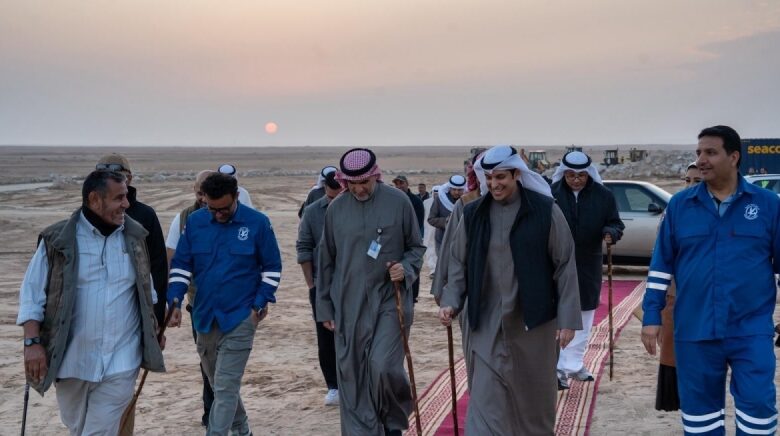
Al-Mutairi made the remarks during an inspection visit to the Kuwait Geopark site, which is supervised by the Ministry of Information and implemented by the Kuwait Oil Company (KOC) in partnership with the Tourism Projects Company, the Earth Sciences Association, and a number of state entities, reports Al-Rai daily.
The visit was to review progress on the ongoing works and monitor preparations at the site, as part of national efforts to highlight Kuwait’s natural and cultural heritage and promote cultural and educational tourism.
The minister emphasized that the project seeks to transform challenges into opportunities through cooperation among all stakeholders, noting that government agencies and the private sector are jointly implementing an integrated national project based on a site of exceptional environmental importance.
He added that a range of activities will be launched within the Geopark to translate the project’s vision into a tangible reality.
Al-Mutairi said early indicators show that the site will become an attractive destination in Kuwait, explaining that the project reflects the country’s environmental and climatic nature and is linked to land with distinct geological characteristics.
He noted that the Geopark will serve as a unique destination for tourists from within and outside Kuwait, offering scientific content and diverse services to create a new desert-themed tourism experience that distinguishes Gulf Cooperation Council countries.
He described the project as an ambitious and promising start, stressing the Ministry of Information’s commitment to expanding partnerships and enabling all parties to contribute their expertise. He reiterated the ministry’s dedication to strengthening Kuwait’s tourism ecosystem in cooperation with government bodies, the private sector and civil society through high-quality, distinctive projects.
Mohammed Al-Abduljalil, Deputy CEO for Planning and Innovation at the KOC, said the Geopark site holds exceptional historical value due to its association with archaeological sites dating back to the Ubaid civilization, which flourished between approximately 5500 and 4900 BC.
He noted that this period represents one of the oldest civilizations in the Arabian Gulf region and reflects early human settlement and cultural interaction along the Gulf’s coasts, giving the site profound historical and human significance.
Al-Abduljalil explained that KOC is responsible for supervising and implementing construction and development works at the site, drawing on its extensive technical and field experience in managing desert and environmental locations.
He added that the company is committed to executing the project according to the highest environmental and technical standards, ensuring the preservation of the site’s geological nature and the protection of its historical landmarks as part of its social and national responsibility.
Located north of Kuwait Bay, the Kuwait Geopark project is a national initiative aimed at reinforcing Kuwait’s position as a global destination for geology, archaeology, natural heritage and human history.
The project is envisioned as an open-air museum and a “living memory” of the country’s environmental and cultural legacy.
The project also seeks to enhance Kuwait’s international standing through inclusion in the global network of geoparks affiliated with UNESCO, while highlighting the historical depth that forms a core part of Kuwait’s national identity.
In addition, it aims to develop eco-tourism and geo-tourism as promising economic sectors that support income diversification, protect natural and geological heritage, raise public awareness through education and interactive experiences, and stimulate scientific research and innovation in earth sciences, environmental studies and cultural heritage.
The first phase of the Kuwait Geopark covers an area of 20 square kilometers, while the second phase will extend to 1,000 square kilometers. Planned facilities include geological and heritage activity centers, cafés, restaurants, handicraft shops, and a dedicated stargazing platform.
Site managers have completed securing and surveying the area, repairing the outer wall, installing the main entrance gate, and planting more than 1,500 native plants, including ghaf, awake, tamarisk, acacia, sedge and wild jujube, in addition to sowing sedge seeds across the site.