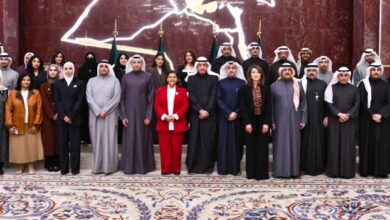



















Combating drugs is collective national responsibility, says Acting Prime Minister and Minister of Interior
. . . ‘Kuwait is targeted, but the law can no longer be broken’: Sheikh Fahd Al-Yousef
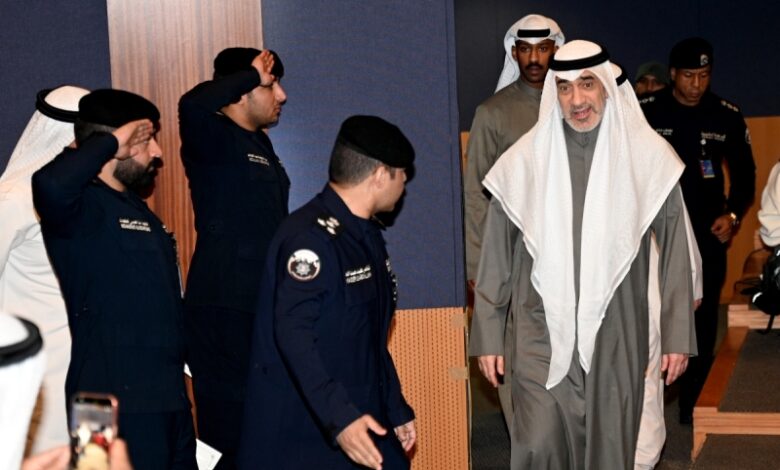
Acting Prime Minister and Minister of Interior Sheikh Fahd Al-Yousef affirmed that fighting drugs is a collective national responsibility, one in which the roles of families, schools, the media, security agencies, and every individual converge.
He stressed that community cooperation with competent authorities is the cornerstone for the success of the new anti-drug law and for achieving its goals.

Al-Yousef made these remarks while delivering a speech at a seminar organized Thursday by the Kuwait Institute for Judicial and Legal Studies, held under his patronage, to discuss Decree Law No. 159 of 2025 on combating drugs, psychotropic substances, and regulating their use and trade. The event gathered a distinguished group of experts and law enforcement officials.
The seminar witnessed powerful human accounts reflecting the gravity of the drug crisis. Al-Yousef recounted a heartbreaking case of a young man who killed his sister under the influence of drugs, saying, “I haven’t slept since yesterday… drugs made him do this.”
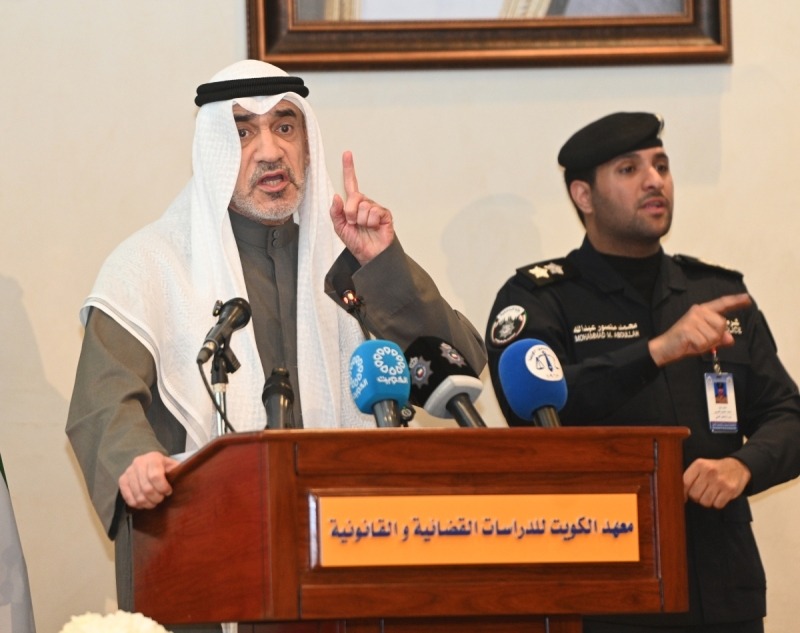
Meanwhile, Court of Appeal Advisor and head of the law-drafting committee, Counselor Muhammad Rashid Al-Duaij, recalled a tragic incident from 25 years ago of an addict killing his mother—an event he said remains etched in his memory.
Al-Yousef declared that Kuwait is standing at “a new juncture characterized by decisive legislation, responsible behavior, and shared responsibility between the state and society.” He warned that Gulf societies are specifically targeted by transnational drug-trafficking networks using sophisticated methods to inject narcotics into the region.

The Minister revealed that efforts by the General Administration for Drug Control and the Ministry’s security sectors had succeeded in eliminating around 90 percent of narcotics that were aimed at Kuwait over the past year — a result he described as evidence of the “efficiency and dedication” of Kuwait’s security personnel.
Following the issuance of the new law, he instructed the General Department of Security Relations and Media, alongside governmental and civil entities, to launch a broad awareness campaign titled “We Protect the Homeland” to introduce the public to the law’s provisions, penalties, and treatment opportunities.
Al-Yousef expressed profound appreciation to His Highness the Amir Sheikh Mishaal Al-Ahmad Al-Jaber Al-Sabah, crediting his unlimited support as the primary factor behind the emergence of a strong, integrated anti-drug law that meets the needs of the current stage.
He also extended thanks to the committee that drafted the law, as well as the Anti-Narcotics Department and all Ministry sectors for their relentless efforts to foil trafficking attempts and enhance preventive measures.
Responding to Advisor Al-Duaij’s remarks, Al-Yousef said emotionally, “You said you worked 27 years and saw what you saw… in the last two years, I have seen more — and harsher — than what you saw.”
He added that Kuwait is being targeted “with everything,” noting that narcotics are not the only danger:
He stressed that Kuwait’s resources, people, and leadership make it a regional example—and consequently a target. “If Kuwait did not possess these resources, we would not see this influx of drugs, nor the rush of people seeking citizenship or work in such large numbers.”
Today, he said, “It has become impossible for anyone to break the law.”
In his remarks, Sheikh Fahd revealed that long-pending death sentences will soon be resolved, “We have about 35 people sentenced to death since 2013. His Highness the Amir was not informed. Today, only seven or eight remain.”
He announced that, before the end of the year, he will seek the Emir’s approval to proceed with the remaining executions, affirming that under the new law, no convict will remain on death row for more than six months.
The Minister praised the Ministry of Health for its role in treating addiction cases, highlighting the transformation of one patient who became a supervisor helping other addicts.
He said Kuwait’s addiction hospital facilities are unmatched, “I challenge anyone to find a hospital in the world with the wing we built. Even hotels do not have such facilities.”
Al-Yousef revealed troubling data, saying, “All addicts are between 16 and 30 years old — there are no older addicts.”
He stressed that the Gulf region remains targeted due to its wealth. While drug circulation in Kuwait has significantly declined, smuggling continues—and authorities recently uncovered drug cultivation inside Kuwait for the first time.
Concluding his remarks, Al-Yousef affirmed, “Kuwait deserves more than what we are doing. We all have children and grandchildren — we must prevent the tragedies faced by today’s generation from reaching the next.”