Kuwait and NATO deepen strategic ties as AI, Cybersecurity dominate regional security talks
Sheikh Jarrah Jaber Al-Ahmad Al-Sabah highlighted the significance of holding the meeting at the NATO Regional Center in Kuwait — “the first of its kind outside NATO territory” — as proof of the depth of the Kuwait-NATO partnership and the Center’s pivotal role in communication and cooperation
The Times Kuwait Report
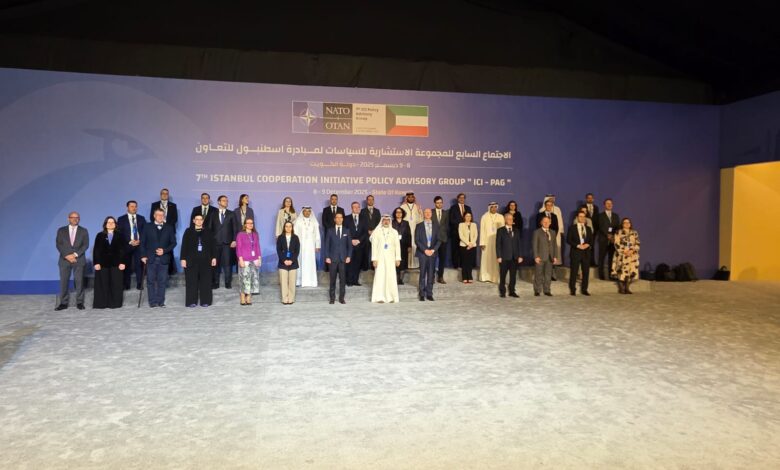
Kuwait remains committed to advancing regional security and strengthening its strategic partnership with NATO as it hosted the 7th meeting of the Istanbul Cooperation Initiative (ICI) Policy Advisory Group at the NATO-ICI Regional Center in Kuwait.
Deputy Foreign Minister Sheikh Jarrah Jaber Al-Ahmad Al-Sabah, who opened the session, described the gathering as a reflection of Kuwait’s unwavering dedication to dialogue and cooperative security.
“I am pleased to welcome you all to this important meeting, which brings together partner countries, experts, and guests from across the region. Your presence reflects our shared commitment to strengthening dialogue, cooperation, and our collective security,” he said.
He noted that Kuwait’s hosting of the meeting for the third time underscores its active role in regional and international efforts to enhance stability.
The Deputy Minister also highlighted the significance of holding the meeting at the NATO Regional Center in Kuwait — “the first of its kind outside NATO territory” — as proof of the depth of the Kuwait-NATO partnership and the Center’s pivotal role in communication and cooperation.
This session, he added, carries additional weight because it is the first to be hosted by the Ministry of Foreign Affairs, reflecting Kuwait’s intent to expand the diplomatic function of the Center and advance its strategic objectives with regional partners and NATO.
Sheikh Jarrah said the focus on artificial intelligence and cybersecurity this year reflects the growing intersection between technology, politics, and security.
“We will discuss a wide range of vital topics, including cooperation under the Istanbul Cooperation Initiative, developments in the political and security environment in the region, shared security perspectives, emerging challenges related to cybersecurity and AI, as well as cooperation in addressing cross-border threats,” he explained.
These issues, he added, “reflect the complexity of the shared security environment and underscore the need for flexible and adaptive cooperation mechanisms.”
The Deputy Minister emphasized the value of the Istanbul Cooperation Initiative as a long-standing platform for meaningful dialogue and coordinated action.
“In a moment marked by profound geopolitical complexity, with rapid regional developments and challenges that transcend borders and institutions, the value of this initiative emerges clearly — as a platform built on mutual respect, partnership, and the firm belief that security is constructed through cooperation, transparency, and shared responsibility,” he said.
He stressed that the meeting provides an opportunity to assess progress and set a roadmap for the next phase of collaboration between Kuwait, ICI partners, and NATO.
“By working together, we can advance our shared goals, support stability, strengthen dialogue, and build a safer and more peaceful region,” he concluded.
Javier Colomina, NATO Secretary General’s Special Representative for the Southern Neighborhood, praised Kuwait for its enduring role in advancing NATO–Gulf relations.
“I am pleased to welcome you to Kuwait for this meeting that brings NATO together with our Gulf partners, reflecting our shared commitment to dialogue and cooperation in pursuit of stability and common security,” he said.
Colomina thanked Kuwait—and in particular the Deputy Foreign Minister—for strong support to the cooperation track, noting that the ICI Regional Center in Kuwait has become one of NATO’s most important hubs for training and education in the region.
He recalled that the NATO–ICI partnership spans more than 20 years, celebrated most recently in New York under the patronage of the Crown Prince of Kuwait.
“We meet at a moment defined by profound security challenges that no country or region can confront alone,” he said.
Colomina outlined global tensions—from the war in Ukraine to regional instability in the Middle East—that heighten the urgency for shared security efforts. He also recognized the diplomatic roles of Qatar, Egypt, and Türkiye in mediation efforts toward a ceasefire.
Colomina highlighted NATO’s renewed focus on the southern neighborhood, pointing to the adoption of the Southern Neighborhood Action Plan, increased defense investments, and the opening of a NATO political liaison office in Amman.
“Political dialogue is more necessary than ever, and practical cooperation must continue to grow to support our shared security,” he said.
He underscored that security in the Gulf and the Euro-Atlantic region is “interconnected,” noting examples such as the use of Iranian drones in Ukraine and the broader impact of geopolitical competition on global food and energy security.
Rapid global shifts, Colomina emphasized, make NATO’s cooperation with regional partners indispensable.
“By working together, we not only strengthen our ability to preserve stability, but also open new horizons in defense innovation and the development of advanced capabilities that benefit both sides,” he said.
Discussions during the meeting are set to cover border security, maritime security, counterterrorism, hybrid threats, emerging technologies, and cybersecurity—key priorities also highlighted by Kuwait’s Deputy Foreign Minister.