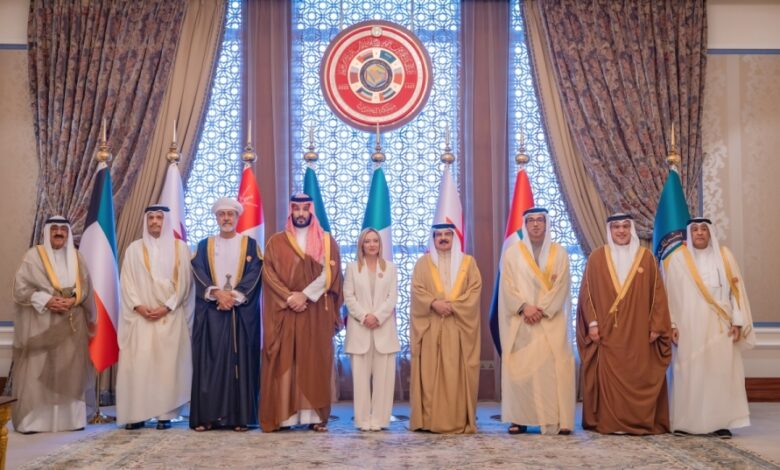
The 46th session of the Supreme Council of the Gulf Cooperation Council (GCC), held in Sakhir, Bahrain, concluded with a strong reaffirmation of the unity, cohesion, and strategic alignment among member states, underscoring the continued transition from cooperation to deeper union and broader horizons of fraternal solidarity.
In its final communiqué, the summit expressed deep appreciation for the sincere and dedicated efforts of His Highness the Amir of the State of Kuwait, Sheikh Mishal Al-Ahmad Al-Jaber Al-Sabah, during Kuwait’s presidency of the 45th session, praising the significant achievements accomplished under his leadership, Al-Rai reports.
The Sakhir Declaration, issued at the conclusion of the summit, emphasized respect for the sovereignty of GCC countries and all states in the region, rejection of interference in internal affairs, and the inadmissibility of using or threatening force.
The leaders stressed the importance of accelerating economic diversification and strengthening innovation- and sustainability-based economies to secure long-term prosperity for Gulf nations. They also underscored the priority of enhancing cooperation in technology, artificial intelligence, and cybersecurity within a unified GCC strategic framework.
Reaffirming the centrality of the Palestinian cause, the Supreme Council called for ending the Israeli occupation and establishing an independent Palestinian state along the 1967 borders.
It stressed support for the Palestinian people in Gaza and commended the efforts of U.S. President Donald Trump, the outcomes of the Sharm El-Sheikh Peace Summit, and the agreement reached regarding Gaza, including the initiation of the first phase aimed at ending the war and laying the groundwork for a comprehensive and just peace. The Council urged all parties to uphold the ceasefire agreement.
The Council reiterated that the Al-Durra field lies entirely within the maritime areas of the State of Kuwait, and that its natural resources in the submerged divided zone adjacent to the Saudi-Kuwaiti divided area are jointly owned solely by Kuwait and Saudi Arabia. It firmly rejected any claims by third parties to rights in the field.
On Iraq, the Council reaffirmed support for the country’s security, stability, territorial integrity, and Arab identity.
It called on Baghdad to honor all bilateral and international agreements, particularly regarding the regulation of navigation in Khor Abdullah, and rejected any encroachment on Kuwait’s sovereignty.
The Council expressed support for Lebanon’s sovereignty and stability, highlighting the need for political and economic reforms.
It emphasized preventing Lebanese territory from being used for terrorism or drug smuggling, welcomed the government’s decision to permit weapons possession throughout the country, and stressed adherence to the ceasefire agreement.
The Supreme Council reaffirmed its firm positions on relations with Iran, calling on Tehran to commit to the principles of the UN Charter, international law, good-neighborliness, respect for state sovereignty, and non-interference in internal affairs.