Kuwait at UN Security Council stresses sovereignty, justice in outstanding files with Iraq
Kuwait’s commitment to constructive cooperation and Iraq’s active participation are essential for successfully resolving longstanding issues -- by Ambassador Tariq Al-Bannai
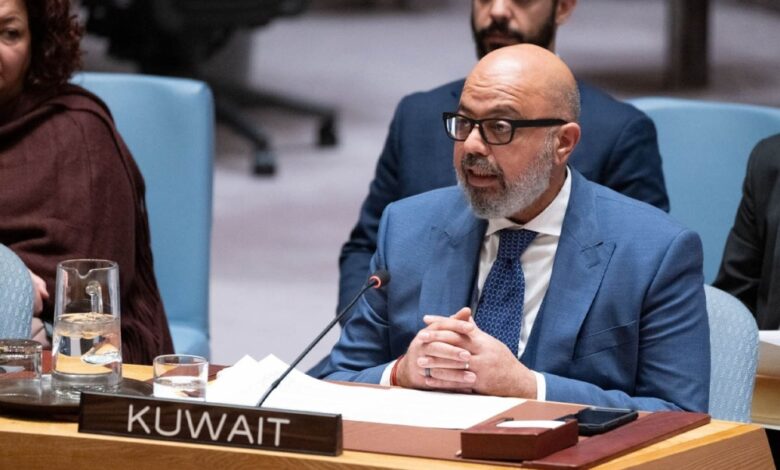
The State of Kuwait reaffirmed that respect for its sovereignty and territorial integrity forms the cornerstone of stable relations with Iraq. Resolving outstanding issues related to Kuwaiti prisoners, missing persons, and properties in a just manner, it said, will significantly strengthen regional stability and consolidate principles of good neighborliness.
This was highlighted by Ambassador H.E. Tariq Al-Bannai, Kuwait’s Permanent Representative to the United Nations, during a UN Security Council session on the United Nations Assistance Mission for Iraq (UNAMI) on Tuesday evening.
Al-Bannai described the latest UN Secretary-General report on outstanding Kuwaiti files as an important reference for assessing progress, particularly following achievements in Tripartite Committee meetings and cooperation with the International Committee of the Red Cross, reports Al-Jarida daily.
He welcomed Iraq’s recent handover of 400 boxes of books and archival materials as a positive step toward recovering the remainder of Kuwait’s property, notably the National Archives.
He stressed that while UNAMI has played a pivotal role in fostering trust and cooperation for over a decade, progress on the missing persons file remains limited, with key sites yet to yield results despite decades having passed. Kuwait called for intensified efforts and the use of direct witness access and advanced technology under UN supervision to expedite these files.
Ambassador Al-Bannai also highlighted the unanimous adoption of Security Council Resolution 2792 (2025), which ensures follow-up on pending humanitarian files beyond the end of UNAMI’s mandate in December. The resolution mandates a high-level UN representative to oversee these issues, safeguarding justice for the families of the missing and facilitating the recovery of remaining national property.
He underscored that Kuwait-Iraq agreements, including Resolution 833 (1993) on land and sea borders, the 2012 Khor Abdullah navigation agreement, and the 2008 security exchange protocol, are binding legal instruments that must be respected. Kuwait rejected any unilateral interpretations or actions by Iraq, including those cited by the Supreme Federal Court of Iraq, as legally null and void.
Al-Bannai concluded by affirming Kuwait’s commitment to constructive cooperation, noting that Iraq’s active participation remains essential for successfully resolving these longstanding issues.