‘Housing reform becomes a national priority with private sector as strategic partner’
Housing vision cannot be summarized in a single concept because it rests on multiple directions and goals, foremost among them expanding the private sector’s role – Minister Al-Mashari
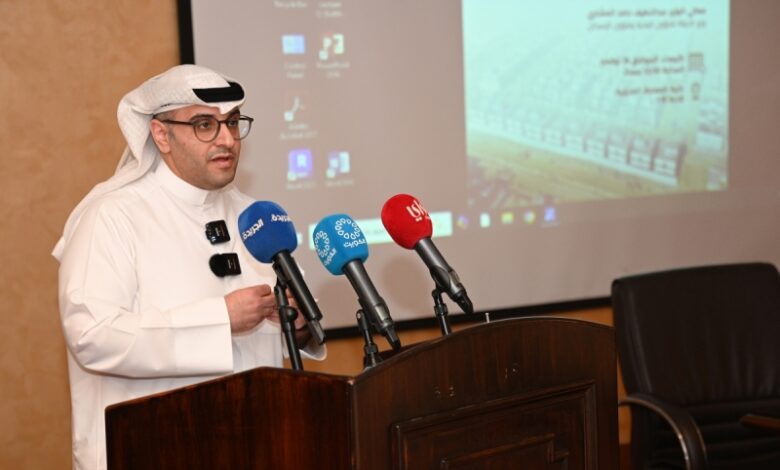
Minister of State for Municipal Affairs and Minister of State for Housing Affairs Abdul Latif Al-Mashari affirmed that resolving Kuwait’s housing challenge is no longer a choice but a national priority.
He said the new direction is built on an accurate reading of current realities, forward-looking planning for future needs, and a legislative framework that enables the private sector to become a genuine partner in financing, design, and implementation—while safeguarding family affordability, housing quality, and the country’s urban identity.
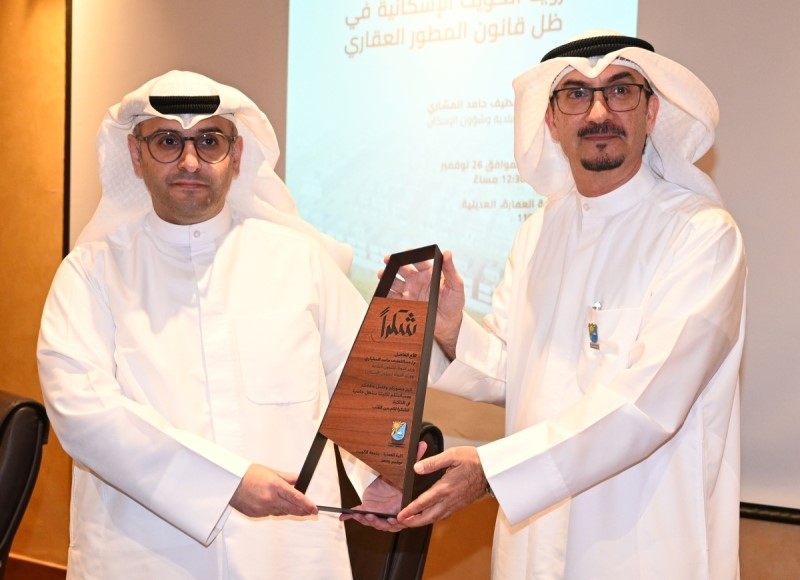
Speaking at a lecture titled “Kuwait’s Housing Vision under the Real Estate Developer Law” at the College of Architecture in Adailiya, Al-Mashari said that shaping the housing vision required a deep understanding of the present situation and the ability to design broader, more comprehensive solutions.
He added that imagining housing models that do not yet exist, and unifying disparate ideas under clear standards, allowed for a modern and innovative framework.
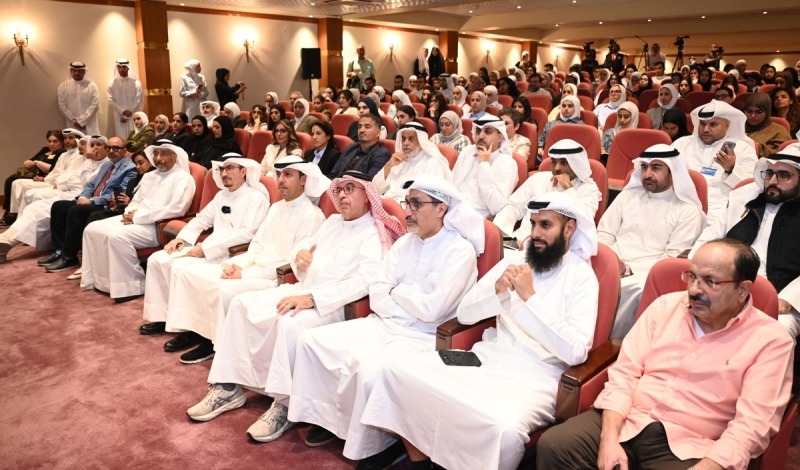
Al-Mashari explained that the housing vision cannot be summarized in a single concept because it rests on multiple directions and goals, foremost among them expanding the private sector’s role.
This partnership, he said, spans all areas where developers can contribute—from management and urban design to construction and, importantly, financing major projects.
He noted that Law 118/2023 positions the private sector as a real partner in delivering the national housing vision. A parallel track involves restructuring the housing system itself to ensure stability and balance within the real estate sector. The goal, he said, is to empower those eligible for housing care, support the real estate market, and modernize the concept of entitlement, acknowledging that families’ needs vary widely.
The minister stressed that diversity of housing units is a core component of the vision—yet one of the most challenging. Kuwait has long followed a single architectural pattern for residential areas, a model that played a major role in shaping the nation socially. However, evolving needs require updated approaches, he said, noting that pivotal projects were introduced under Law 118 to offer new housing models.
Al-Mashari revealed that several unconventional projects are under study, including vertical housing, which may suit specific segments when built in prime locations. Among these is the Al-Mirqab project in the heart of Kuwait City, currently under review.
Another is the Sulaibikhat Beach project, a qualitative development referred by the Cabinet to the Public Authority for Housing Welfare to be offered to developers as a sea-view residential opportunity. He said such projects will introduce residential patterns not previously available in Kuwait.
He added that residential unit sizes offered by developers will be shaped by market studies, allowing for wider choices and more flexibility in pricing. Smaller units would be more affordable, while larger units would remain available for buyers seeking more space. “Every citizen will find an option that suits his family’s needs,” he said.
According to Al-Mashari, the initial study for the first three real estate developer projects includes 5,000 housing units, forming the first package of developer-led offerings. Additional projects are being evaluated for inclusion in the second and third packages.
Key sites under consideration include Al-Mirqab and Sulaibikhat Beach, both seen as strategic locations for high-density residential development.
The minister emphasized that the real estate developer model is an important tool, but not the only solution. The Housing Authority is currently assessing infrastructure readiness in all new projects, and no distribution will proceed without clear plans and precise timelines to ensure citizens are not negatively affected. He clarified that suspending land distribution remains tied to infrastructure completion.
Al-Mashari said available developer opportunities currently range from 1,000 to 2,000 housing units, which allows Kuwait to begin with medium-sized projects led by experienced developers. He assured citizens that housing prices will align with the limits set by the Real Estate Finance Law, and no project will be offered beyond the means of the majority.
He announced that the Real Estate Finance Law is in its final review phase, emphasizing that, for the first time, Kuwaiti families will be able to own homes through bank financing.
Regarding architectural identity, the minister said Law 118 allows developers to create areas distinguished by specific architectural styles—whether Kuwaiti, modern, or mixed—contributing to neighborhoods with clear and unique urban character.
He confirmed that Jleeb Al-Shuyoukh is not included in current housing plans, noting that its properties are privately owned and that efforts are focused solely on urban development, with no valuation plans at present.
Deputy Director General of the Projects Sector, Eng. Ahmed Al-Ansari, said Kuwait currently has 105,000 housing applications, with about 8,000 added annually, underscoring the urgency of expanding sustainable residential options. He said consultancy contracts have already been issued for major roadworks in Al-Sabriya and Al-Khairan, and efforts are underway to accelerate infrastructure readiness in both areas.