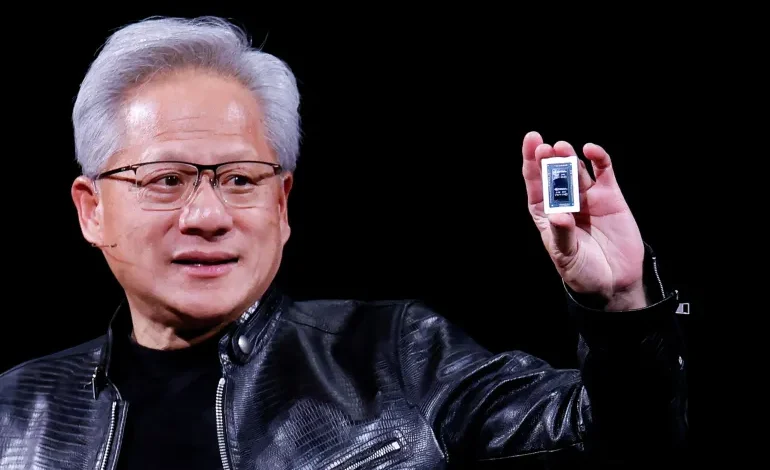
• Reports of Jensen Huang’s departure following allegations involving a suspected Chinese intelligence operative and a company executive have put the AI chipmaker under intense scrutiny.
• Nvidia’s reported market valuation has slipped below $4 trillion, while questions over corporate leadership, national security and investor confidence dominate attention.
• For a company at the centre of the global AI investment boom, the immediate challenge extends beyond its share price. The unfolding controversy places corporate governance, leadership continuity and technology security under the spotlight at a time when Nvidia’s strategic importance to the global economy has never been greater.
Nvidia, the world’s leading supplier of advanced artificial intelligence chips, is facing an unprecedented leadership crisis following reports that its co-founder and chief executive, Jensen Huang, has stepped down amid allegations concerning his personal relationships and possible national security implications.
According to reports, Nvidia’s board convened to discuss Huang’s position after allegations emerged linking him to Alice Huang, a former executive at Singapore-based Megaspeed, a major business partner of the American chipmaker in Southeast Asia. The allegations have reportedly prompted scrutiny by the Federal Bureau of Investigation, the US Congress and the company itself.
The controversy has also raised questions about the security of advanced semiconductor technology, particularly amid Washington’s restrictions on exports of sophisticated AI chips to China over concerns about their potential military and intelligence applications.
Megaspeed, established in 2023, has reportedly come under investigation over allegations that it may have helped Chinese companies gain access to Nvidia chips. The company has been associated with a substantial inventory of advanced semiconductors, reportedly valued at $4.8 billion.
Nvidia’s reported leadership transition comes at a particularly sensitive time for the technology giant, whose products underpin much of the global expansion of artificial intelligence infrastructure.
The company’s shares reportedly declined by around 10 percent in early trading on Thursday, with its market capitalisation falling below the $4 trillion threshold for the first time since 2025. The technology-heavy Nasdaq also recorded a decline, reflecting broader pressure on technology stocks.
Reports identified Nvidia Chief Financial Officer and Executive Vice President Colette Kress as interim chief executive, while Harvey C. Jones, a longtime venture investor, was appointed the company’s first board chair.
Huang, 63, co-founded Nvidia and built it into one of the most influential companies in the global technology industry. Holding approximately 3.6 percent of its shares, he remains one of the world’s wealthiest business figures and a central personality in the development of the AI economy.
His influence has extended beyond corporate leadership. Huang has advocated easing US restrictions on advanced chip exports to China, arguing for greater access to international markets. US President Donald Trump previously said Huang had told him he had no knowledge that he was involved with an intelligence operative.
The controversy has also reportedly exposed Nvidia to a shareholder class-action lawsuit, adding a further corporate and financial dimension to the unfolding developments.
Aleksandar Tomic, associate dean for strategy, innovation and technology at Boston College, told Al Jazeera that Huang’s reported departure could have an unusually significant impact because of Nvidia’s relatively flat organisational structure.
However, Tomic expressed confidence in the company’s ability to navigate the leadership transition, describing the development as a temporary setback rather than a fundamental threat to its business.
He said Nvidia remained in a strong position, supported by its products and market standing, adding that the company could manage the succession process despite the sudden nature of the development.
The developments come as investors await Nvidia’s forthcoming quarterly earnings announcement, which is expected to provide further insight into demand for AI chips, the company’s financial performance and the outlook for the wider semiconductor industry.
For a company at the centre of the global AI investment boom, the immediate challenge extends beyond its share price. The unfolding controversy places corporate governance, leadership continuity and technology security under the spotlight at a time when Nvidia’s strategic importance to the global economy has never been greater.