Kuwait underscores UN vital role of political missions in peacekeeping, conflict prevention

The State of Kuwait reaffirmed Wednesday the critical role executed by United Nations special political missions, describing them as indispensable instruments for preventive diplomacy, conflict prevention, peaceful dispute settlement, and sustainable peace-building.
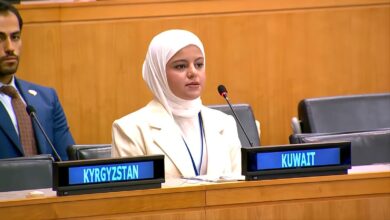
The statement was delivered by Kuwait’s Diplomatic Attache Abdulaziz Al-Humaida before the Fifth Committee (Administrative and Budgetary) of the UN General Assembly during a session focusing on special political missions.
Al-Humaida stressed the necessity of fully empowering these missions to carry out their mandates efficiently by providing financial and human resources proportional to their operational responsibilities and field challenges, while maintaining high standards of transparency, accountability, and fiscal management.
He emphasized the importance of aligning allocated resources with assigned responsibilities to ensure operational sustainability. In this regard, he urged closer coordination among UN bodies, knowledge-sharing, and capacity-building to optimize performance and resource efficiency.
Detailing Kuwait’s historical contributions to UN peacekeeping and diplomatic efforts, Al-Humaida highlighted that Kuwait hosted the United Nations Iraq-Kuwait Observation Mission (UNIKOM) for 12 years until 2003, financing two-thirds of its budget.
He also addressed the UN Security Council’s adoption of Resolution 2792 (2025), which maintains UN oversight on the files of missing Kuwaiti citizens, third-country nationals, and stolen Kuwaiti property, including the national archives.
Al-Humaida expressed Kuwait’s commitment to collaborating closely with Ms. Mari Yamashita, High-Level Coordinator for the resolution’s implementation, and thanked Security Council members for their support on these essential humanitarian and national issues.
In conclusion, Al-Humaida reiterated Kuwait’s unwavering support for the United Nations in advancing global peace and security in alignment with the principles of the UN Charter.
— KUNA