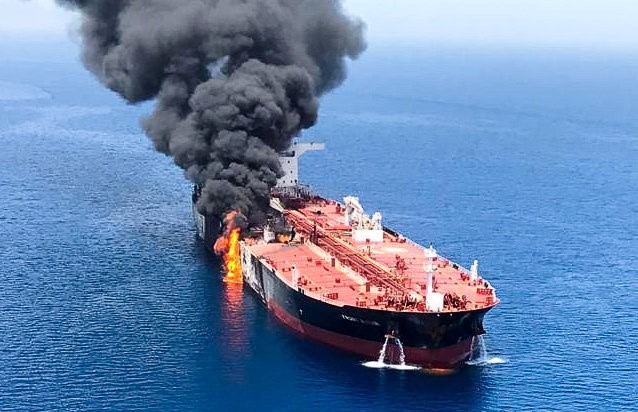
The United States military struck five Iranian oil tankers on Tuesday, escalating tensions between Washington and Tehran and raising fresh concerns over the security of oil shipments in the Gulf and Strait of Hormuz. US Central Command (CENTCOM) said the strikes followed two ballistic missile attacks by Iran’s Islamic Revolutionary Guard Corps (IRGC) against a US Navy warship over the previous two days.
According to CENTCOM, the US warship successfully evaded both attacks and continued patrolling regional waters. No American personnel were injured. CENTCOM said the crews of the targeted tankers were ordered to abandon their vessels shortly before the strikes. There were no immediate reports of casualties.
Iranian media reported explosions near the southern port of Jask and Kharg Island, two strategically important locations for Iran’s oil exports. US forces struck four Iranian oil tankers in the Gulf of Oman: M/T Kaviz, M/T Charminar, M/T Horizon 1 and M/T Riesco.
Iran threatens retaliation
A fifth vessel, M/T Derya, was targeted near Kharg Island in the Strait of Hormuz. CENTCOM said all five vessels were linked to the IRGC, accusing Iran of using the tankers as part of a multibillion-dollar “shadow network” to finance the IRGC and its regional proxies.
The US military also said Iran lacked the means to defend the vessels. Iranian state media subsequently reported that Tehran launched missiles toward US targets in Jordan, a US ally that hosts an American military facility.
Jordan’s military said its air defence systems engaged 20 ballistic missiles launched toward Jordanian territory and intercepted 18 of them. The remaining two missiles fell in unpopulated areas, according to the Jordanian army. The IRGC also claimed it had targeted two US ships, eight oil tankers and 10 other vessels that it described as “non-compliant” and attempting to pass through what it called a prohibited and unsafe maritime zone.
The escalation has also raised concerns for Gulf shipping. Earlier on Wednesday, the IRGC specifically warned oil tankers in Kuwaiti and Bahraini ports to leave their vessels, saying they could be targeted whether they were anchored or docked. The threats add another layer of risk to commercial shipping and energy markets in the Gulf, particularly around the Strait of Hormuz, a critical route for global oil transportation.