

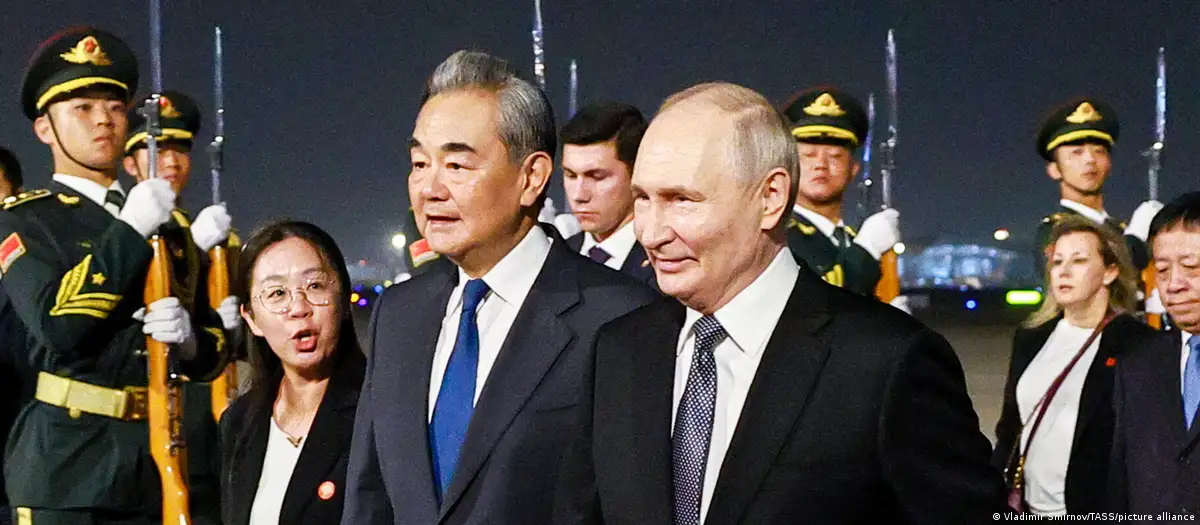
Russian President Vladimir Putin arrived in Beijing for a crucial round of talks with Chinese President Xi Jinping, as Moscow and Beijing moved to strengthen what both sides describe as a growing strategic partnership aimed at reshaping the global balance of power.
Ahead of the summit, the Kremlin announced that Putin and Xi are expected to sign a major joint statement promoting a “multipolar” world order, a concept frequently used by both Russia and China to challenge what they see as Western dominance in international affairs.
The declaration is among nearly 40 agreements expected to be signed during the visit, covering sectors including trade, transport, construction, industry and energy cooperation.
Putin landed at Beijing Capital International Airport late Tuesday night and was welcomed by senior Chinese officials and a ceremonial guard of honor, underscoring the importance Beijing places on the visit.
The Kremlin said the two leaders would also hold informal discussions “over tea,” where they are expected to exchange views on the wars in Ukraine and Iran, as well as broader regional and global developments.
The visit comes at a time when Russia has become increasingly dependent on China economically following sweeping Western sanctions imposed after Moscow’s invasion of Ukraine in February 2022.
China has emerged as the largest buyer of Russian oil and a key economic lifeline for the Kremlin, helping cushion the impact of Western isolation.
In a video message released before his departure, Putin described relations between Moscow and Beijing as being at an “unprecedented level,” praising the rapid growth in bilateral trade and the strategic importance of the partnership, dw.com reports.
“The close strategic relationship between Russia and China plays a major stabilizing role globally,” Putin said, while emphasizing that the alliance is “not directed against anyone.”
Energy cooperation is expected to dominate part of the discussions, particularly the proposed “Power of Siberia 2” gas pipeline project, which would transport Russian natural gas to China through Mongolia.
The project is viewed as a critical long-term economic opportunity for Moscow as it seeks alternatives to European markets.
Meanwhile, European leaders are closely watching the Beijing talks. German Chancellor Friedrich Merz expressed hope that Xi would use his influence with Putin to push for an end to the Ukraine conflict, although Berlin acknowledged it does not expect any major shift in the deepening China-Russia relationship.
China has consistently avoided condemning Russia’s military actions in Ukraine and has instead called for negotiations and a political settlement, while criticizing what it describes as a lingering “Cold War mentality” among Western powers.
The summit further highlights the accelerating alignment between Moscow and Beijing at a time of rising geopolitical tensions, with both nations seeking to project themselves as counterweights to the United States and its allies.